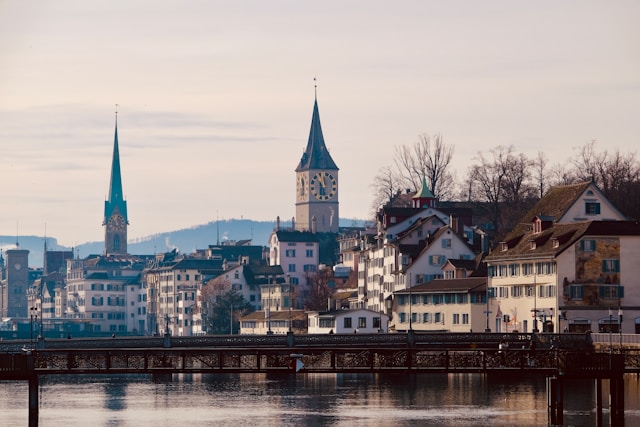
Start a GmbH in Switzerland.
Form your own Gesellschaft mit beschränkter Haftung (LLC) from scratch. Lower capital, simpler governance — Switzerland's most popular business entity for SMEs, startups, and consultants.
What Is a GmbH (Gesellschaft mit beschränkter Haftung)?
The GmbH — Gesellschaft mit beschränkter Haftung — is the Swiss equivalent of a limited liability company (LLC). It is the most popular corporate form in Switzerland, chosen by the majority of new business formations each year due to its lower capital threshold and straightforward governance structure.
Governed by Articles 772–827 of the Swiss Code of Obligations (OR), the GmbH provides its members (quota holders) with limited liability while requiring only CHF 20,000 in share capital — fully paid in at incorporation per Art. 773 OR.
The GmbH is ideal for SMEs, consulting firms, startups, and family businesses that want the protection of a corporate structure without the higher capital and governance demands of an AG. For a broader view of all entity types, see our company formation overview.
Why Form a GmbH in Switzerland
Lower Capital
Only CHF 20,000 in share capital, 100% paid in at incorporation. Five times less than an AG — making it the most accessible Swiss corporate form.
Simpler Governance
Less formal than an AG. No requirement for a separate board of directors — managing directors run the company directly. Ideal for lean operations.
Limited Liability
Members' liability is limited to their capital contribution. Personal assets remain protected, just as with an AG.
Most Popular Form
The GmbH accounts for the majority of new Swiss company formations. Banks, partners, and clients are fully familiar with the structure.
GmbH Formation at a Glance
Min. Capital
CHF 20K
Paid-In at Start
100%
Timeline
3–4 Weeks
Min. Directors
1
Min. Members
1
Audit Opt-Out
<10 FTE
Who Is the GmbH For?
SMEs & Family Businesses
The GmbH's lower capital requirement and flexible governance make it the natural choice for small and medium enterprises. Many Swiss family businesses operate as GmbHs for generations.
Startups & Entrepreneurs
With only CHF 20,000 to get started, the GmbH lets founders preserve capital for growth. It provides full corporate credibility without the overhead of an AG.
Consultants & Freelancers
Independent professionals who want to separate personal and business liability often choose the GmbH. It is straightforward to administer and signals professionalism to clients.
The Formation Process
Draft Articles of Association
The articles of association (Statuten) define the company's name (including "GmbH"), registered office, purpose, share capital, quota structure, and governance rules. We draft these to your specifications while ensuring compliance with Swiss law.
Capital Deposit
A capital deposit account (Kapitaleinzahlungskonto) is opened at a Swiss bank. The full CHF 20,000 (or more, if you choose higher capital) must be deposited before the notarial deed — 100% paid-in is mandatory for a GmbH under Art. 773 OR.
Notarial Deed of Incorporation
The founders appear before a Swiss public notary to execute the deed of incorporation. This includes adoption of the articles, appointment of managing directors and auditor (if applicable), and subscription of quotas. A licensed auditor confirms the capital contribution.
Commercial Register Entry
The notary files the incorporation documents with the cantonal commercial register (Handelsregisteramt). The GmbH legally comes into existence upon registration. The entry — including all quota holders and their quotas — is published in the Swiss Official Gazette of Commerce (SOGC / Zefix). This typically takes 1–2 weeks.
Post-Registration Setup
After registration, the capital deposit account is converted to a regular business account. You register for VAT (if applicable), set up social security contributions (AHV/IV), arrange insurance, and begin operations. We assist with all post-registration compliance steps.
Formation Timeline
Preparation
Draft articles of association, verify company name availability, collect founder identification documents.
Capital Deposit
Open capital deposit account at a Swiss bank and transfer the full CHF 20,000 share capital (100% paid-in required).
Notarial Deed
Execute the deed of incorporation before a Swiss public notary. Appoint managing directors and auditor.
Register Entry
Notary submits documents to the commercial register. GmbH comes into legal existence upon registration.
Go Operational
Convert deposit account, register for VAT and social security, begin business operations.
Key Legal Requirements
Articles of Association
The articles must contain the company name (including "GmbH"), registered office, purpose, share capital amount and currency, the quotas and their nominal values, and the rules for convening members' meetings. Unlike an AG, all quota holders and their quota amounts are registered publicly.
Managing Director
The GmbH must have at least one managing director (Geschäftsführer). Under Art. 814 OR, at least one person authorized to represent the company must be domiciled in Switzerland. By default, all quota holders are managing directors, but the articles can designate specific persons. If you do not have a Swiss-resident director, our nominee director service covers this requirement. Alternatively, you can appoint a Swiss-resident managing director who is not a quota holder.
Quota Holders & Privacy
Unlike AG shareholders, GmbH quota holders are registered in the commercial register with their names and quota amounts. This means ownership is publicly visible on Zefix. If ownership privacy is a priority, the AG structure may be more suitable.
Audit Requirements
The same three-tier audit framework applies as for an AG:
- Ordinary audit: Required if the GmbH exceeds two of: CHF 20 million revenue, CHF 40 million balance sheet total, 250 FTE employees.
- Limited audit (review): Applies to all other GmbHs by default.
- Opt-out: If the GmbH has fewer than 10 FTE and all quota holders unanimously consent, the company can opt out of auditing entirely.
Ongoing Obligations
After formation, your GmbH must maintain proper bookkeeping and prepare annual financial statements in accordance with Swiss GAAP. Federal and cantonal/communal tax returns must be filed annually. A registered office address in Switzerland must be maintained. Our accounting and tax team handles all of this for you. You also need a registered office in Switzerland at all times.
Not Sure Which Entity?
The GmbH and AG are the two main Swiss corporate forms. The GmbH wins on cost and simplicity; the AG wins on privacy and capital flexibility.
Start Your GmbH
Contact us for a free initial consultation. We handle every step from articles of association to commercial register entry — so you can focus on building your business.
Complementary Services
Registered Office
Prestigious Zurich business address to serve as your GmbH's official registered office.
Accounting & Tax
Ongoing bookkeeping, annual accounts, and tax filings to keep your new GmbH fully compliant.
Bank Account
We open your capital deposit account and convert it to a full business account after registration.
Shelf Company GmbH
Need a company faster? Buy a pre-registered, debt-free GmbH and start operating in 24–48 hours.
Frequently Asked Questions
What is the minimum capital for a Swiss GmbH?
The minimum share capital for a Swiss GmbH is CHF 20,000, and it must be 100% paid in at the time of incorporation (Art. 773 OR). This is significantly lower than the AG's CHF 100,000 minimum, making the GmbH more accessible for startups and small businesses.
How long does it take to form a GmbH in Switzerland?
A typical GmbH formation takes 3 to 4 weeks from start to commercial register entry. The timeline depends on document preparation, the notarial appointment, and processing time at the commercial register office.
Can a foreign national form a Swiss GmbH?
Yes. There are no nationality restrictions on founding or owning a Swiss GmbH. However, at least one managing director with individual signatory power must be resident in Switzerland (Art. 814 OR). Foreign founders can use a nominee director service to meet this requirement.
What is the difference between a GmbH and an AG?
The GmbH requires only CHF 20,000 capital (vs. CHF 100,000 for an AG) and has simpler governance. However, GmbH quota holders are listed in the commercial register (less privacy), and quota transfers require notarial form. The AG offers more anonymity and easier share transfers but has higher capital requirements. Read our full AG vs GmbH comparison.
Should I buy a shelf GmbH or form a new one?
A shelf GmbH gives you an operational company within 24–48 hours, ideal when speed matters. Forming a new GmbH takes 3–4 weeks but lets you customize the articles of association, capital structure, and purpose clause from scratch.
How much does it cost to form a GmbH in Switzerland?
Beyond the CHF 20,000 share capital, formation costs typically include notary fees (CHF 1,000–2,500), commercial register fees (approx. CHF 600), and professional advisory fees. Total out-of-pocket costs (excluding share capital) generally range from CHF 2,500 to CHF 6,000 depending on complexity.
Does a GmbH need a managing director resident in Switzerland?
Yes. Under Art. 814 OR, at least one managing director (Geschäftsführer) with individual signatory power must be domiciled in Switzerland. This can be fulfilled through a nominee director arrangement if no founder or employee is Swiss-resident.
How are GmbH quotas transferred?
Unlike AG shares, GmbH quota transfers require a written assignment agreement in notarial form (public deed). The transfer must also be entered in the commercial register. The articles of association may impose additional restrictions, such as requiring approval from the members' meeting.
Can one person form and own a Swiss GmbH?
Yes. A single person can found and own 100% of a Swiss GmbH. There is no requirement for multiple quota holders. The sole member can also serve as the sole managing director, provided they meet the Swiss residency requirement.
What are the annual obligations of a Swiss GmbH?
Ongoing obligations include preparing annual financial statements, filing federal and cantonal tax returns, holding an annual members' meeting, and maintaining a registered office in Switzerland. Annual costs typically range from CHF 3,000 to CHF 10,000 for a small GmbH, covering accounting, tax advisory, and domicile fees.
Are GmbH quota holders publicly visible?
Yes. Unlike AG shareholders, GmbH quota holders and their respective quota amounts are registered in the commercial register and publicly visible on Zefix. If privacy is a priority, the AG may be a better choice.
Does a Swiss GmbH need an auditor?
The same audit thresholds apply as for an AG. An ordinary audit is required if the GmbH exceeds CHF 20 million in revenue, CHF 40 million in assets, or 250 FTE employees. A limited audit applies to smaller companies. A GmbH can opt out entirely if it has fewer than 10 FTE and all quota holders consent.